
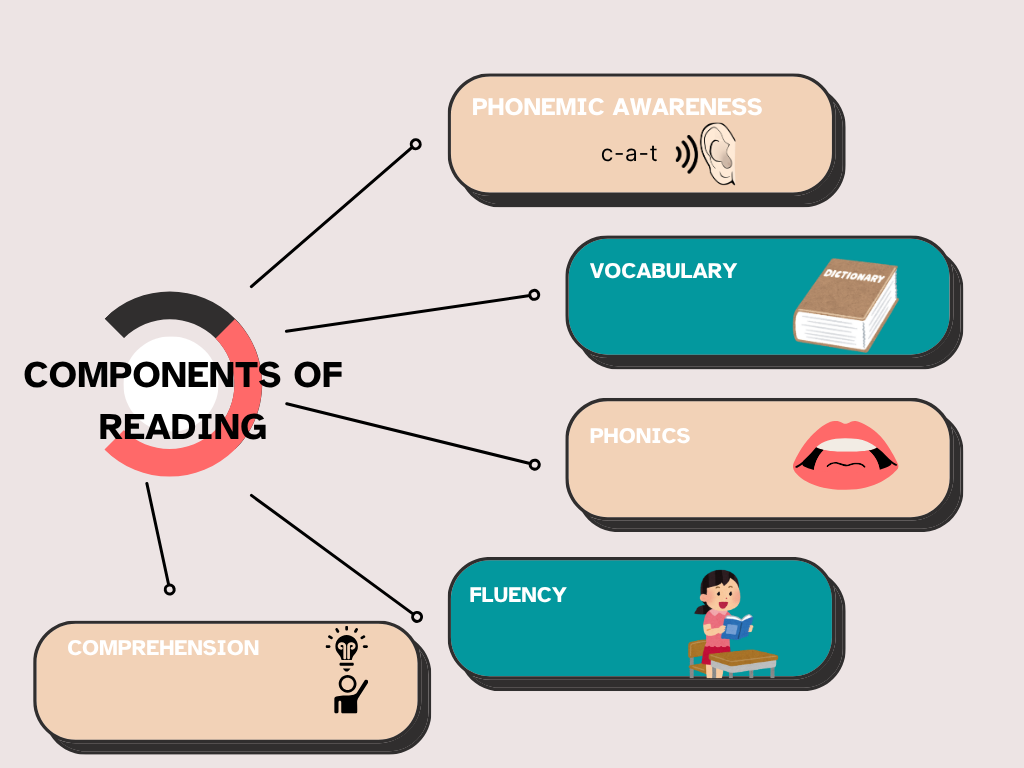
The Science of Reading refers to a broad body of interdisciplinary research—from cognitive psychology, linguistics, neuroscience, and education—that explains how children learn to read and why evidence-based instruction is essential (Castles, Rastle, & Nation, 2018).
This research shows that skilled reading is not intuitive or natural—it’s a learned process that relies on both decoding skills and language comprehension (Gough & Tunmer, 1986). Children benefit most from explicit, systematic, and structured instruction, especially those with dyslexia or other learning differences (Moats, 2020).
Key reading components supported by research include:
Approaches like Sounds-Write are grounded specifically in supporting children to improve their phonemic awareness, phonics and fluency, helping children build strong foundations for reading and spelling through explicit teaching of sound-letter correspondence, blending, segmenting, and word-level strategies (Sounds-Write, 2021).

Building Strong Foundations in Reading
When your child is learning to read, the books they encounter can make all the difference. Decodable readers are specially designed to support early reading development by aligning with phonics instruction. Unlike traditional vocabulary-rich books, which often rely on memorisation and guessing, decodable readers give children the tools to decode words independently—building confidence, fluency, and long-term success.
Decodable readers use controlled vocabulary based on the phonics patterns a child has already been taught. For example, if your child has learned the sounds for “s,” “a,” and “t,” they might read a sentence like “Sam sat.”
These books:
They are especially helpful for children with dyslexia or other reading difficulties, offering a structured path to literacy.
Traditional books—often called leveled or predictable readers—focus on rich vocabulary and engaging stories. While they’re wonderful for read-alouds and building oral language, they can be challenging for early readers who haven’t yet mastered decoding.
| Feature | Decodable Readers | Traditional Vocabulary-Rich Books |
|---|---|---|
| 🔠 Word Selection | Based on taught phonics patterns | Broad vocabulary, often untaught words |
| 🧠 Reading Strategy | Sounding out using phonics | Guessing from pictures or context |
| 🎯 Instructional Purpose | Reinforce decoding and phonics skills | Build comprehension and vocabulary |
| 🧒 Reader Independence | High (child can decode most words) | Low (child may rely on adult support) |
| 📚 Best Use | Early reading and intervention | Read-alouds and advanced readers |
Decodable readers are not “forever books”—they’re stepping stones. Once children develop decoding fluency, they can transition to richer texts with confidence.
Decodable readers allow children to apply what they’ve learned in phonics lessons in real reading situations. This repeated practice:
For children who struggle with reading, these books offer a sense of success and independence that traditional texts may not provide.

For children who find reading and writing challenging—especially those with dyslexia, dysgraphia, or other learning differences—assistive technology can offer meaningful support. Two widely used tools, speech-to-text and text-to-speech, help students access learning and express their ideas more confidently.
Speech-to-text technology allows students to speak into a device and have their words converted into written text. This is especially helpful for children who:
Research shows that students using speech-to-text tools can produce longer and higher-quality written work, with reduced stress around spelling and grammar. It also helps students focus on content rather than mechanics, encouraging more thoughtful and fluent writing.
Text-to-speech technology reads written content aloud—whether it’s a webpage, worksheet, or digital book. This supports students who:
Studies have found that text-to-speech tools improve reading comprehension and fluency for students with dyslexia, while also boosting motivation and independence. By hearing the words spoken aloud, students can focus on meaning rather than decoding, which supports deeper understanding.
These technologies don’t replace literacy instruction—they complement it. They allow students to:
When paired with structured literacy intervention, assistive technology helps children thrive academically while reducing frustration and fatigue.